Battle Ground's position at 600 feet on the Chehalem plateau delivers 45 inches of annual rainfall and 12 or more freeze-thaw events per year — conditions that compress the practical lifespan of pressure-treated wood decks significantly below what valley-floor communities experience. Families who chose Battle Ground for its larger lots, rural character, and room for outdoor living deserve a deck that performs across the Pacific Northwest's most demanding elevation conditions without annual maintenance demands. Left Coast Exteriors builds and replaces decks throughout Battle Ground and north Clark County using TimberTech and Fiberon composite systems that don't rot, splinter, or require the ongoing maintenance that wood decks demand in this climate.
Composite decking doesn't rot. It doesn't develop nail pops from freeze-thaw cycling because it's installed with hidden fastener systems. TimberTech AZEK's full PVC construction and Fiberon's capped composite construction both resist moisture at Battle Ground's rainfall levels without the board checking and splitting that wood decks develop over repeated wet-season cycles. For Battle Ground homeowners who chose the community for its large lots and outdoor living character, a composite deck that remains safe and attractive for 25–30 years without annual maintenance is the right standard — not a wood replacement on a 12–15 year cycle.
Every Battle Ground deck project starts with a structural assessment that addresses the framing, ledger connection, and post condition before any new decking goes on. Battle Ground's elevated rainfall means ledger flashing condition and post integrity receive specific attention — both failure modes are accelerated in this climate relative to valley-floor communities. We handle City of Battle Ground permit applications and inspection scheduling on every project. Battle Ground has its own building division with permit requirements separate from Clark County, and we're familiar with the local process.
Not every deck problem requires full replacement. Here's how we think about it. Full deck assessment guide →
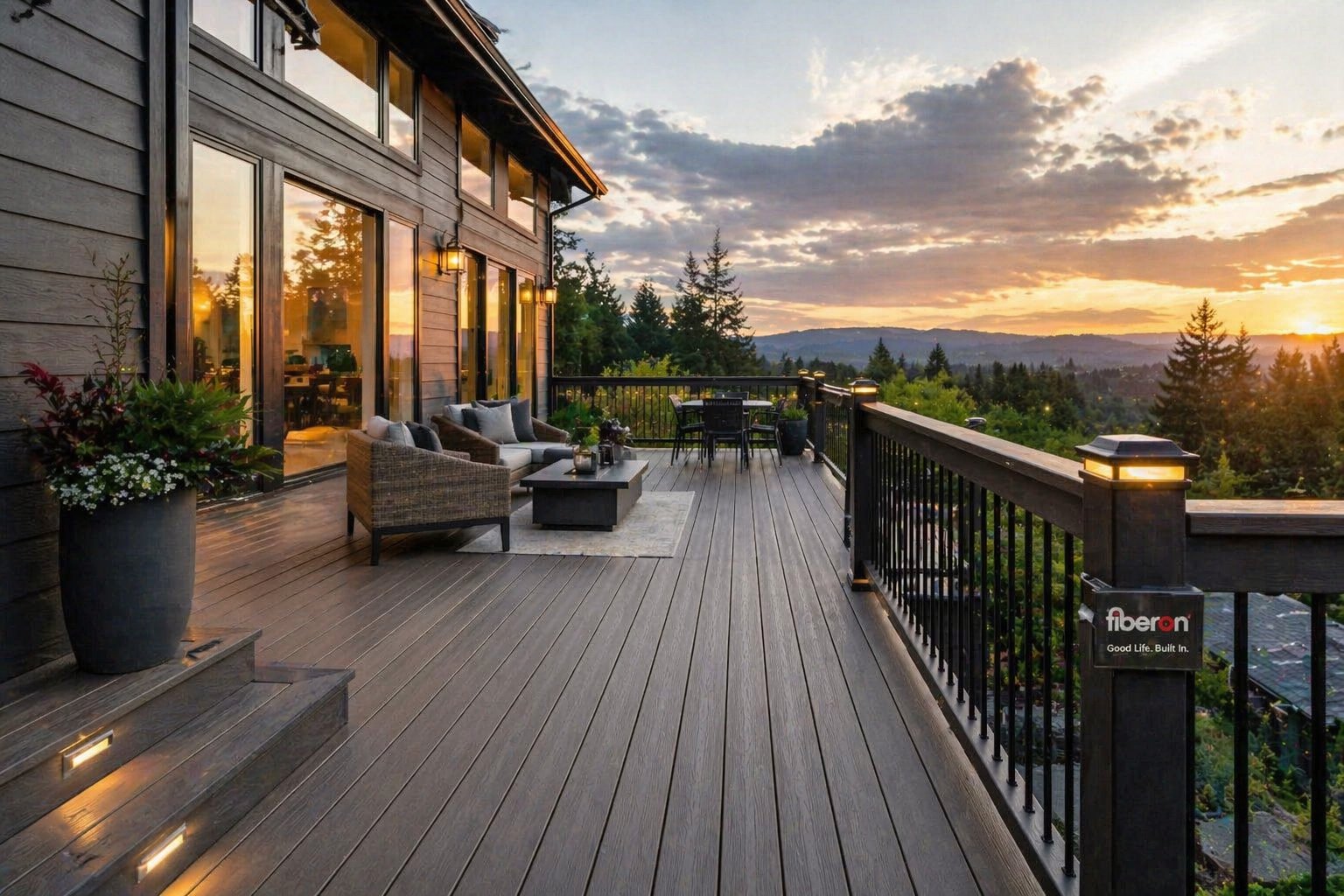
We build with TimberTech and Fiberon composite systems. Two tiers cover most Battle Ground projects. For Battle Ground's freeze-thaw environment, AZEK's full PVC construction is our most frequent recommendation. See our full composite decking guide →
TimberTech AZEK is full PVC — zero wood fiber content, zero moisture absorption pathway, zero freeze-thaw degradation pathway. In Battle Ground's elevated-rainfall freeze-thaw environment, AZEK's complete immunity to moisture-driven failure makes it the strongest specification available. Backed by TimberTech's 30-year fade and stain warranty and lifetime limited structural warranty. For Battle Ground homeowners who want the lowest-maintenance, longest-performing deck available — one that genuinely doesn't require annual sealing, staining, or board replacement — AZEK is the right answer.
Fiberon composite blends wood fiber with PVC and protective polymer capping — a well-proven mid-grade composite that performs reliably in PNW moisture conditions and delivers natural wood appearance at a lower price point than full PVC. Fiberon's capped construction resists moisture far better than uncapped composites and significantly better than pressure-treated wood. Backed by Fiberon's 25-year warranty, it's the right specification for Battle Ground homeowners who want composite performance without the AZEK premium — and who are replacing a wood deck that's been a maintenance burden through multiple wet seasons.
Battle Ground's elevated rainfall, frequent freeze-thaw cycles, and large-lot outdoor living demand make composite the practical standard for north Clark County decks.
Battle Ground receives significantly more annual precipitation than valley-floor Clark County communities — 45 inches versus 37–38 inches in Vancouver — concentrated in a long wet season that keeps wood deck boards at higher sustained moisture levels. Combined with 12 or more annual freeze-thaw events that repeatedly saturate and freeze those moisture-laden boards, Battle Ground's deck environment is one of the most demanding in the service area. Pressure-treated wood's 18–20 year performance window in standard PNW conditions compresses to 12–15 years at Battle Ground's elevation and rainfall. Composite decking's resistance to moisture absorption means the freeze-thaw cycle has no equivalent degradation effect — it simply doesn't have the moisture pathways that allow freeze damage to occur.
Families who chose Battle Ground over Vancouver or Camas did so for the larger lots, more space, and semi-rural character that makes outdoor living a genuine part of daily life. A larger property creates both more opportunity and more expectation for quality outdoor living spaces. Battle Ground's deck projects tend toward larger footprints and more complex configurations than typical suburban Clark County installations — which makes the investment in composite over wood more proportionally justified. A 400–600 square foot Battle Ground deck that lasts 25 years without maintenance is a fundamentally different value proposition than the same deck in wood that needs replacement at 15 years.
The City of Battle Ground requires a building permit for deck construction and replacement projects, and the permit process includes structural review for ledger attachment, post footings, and load calculations. A deck built without permits creates a resale disclosure problem and a liability issue if there's ever a structural failure — particularly on larger Battle Ground decks where structural loads and ledger connections are meaningful. We handle the full permit application, structural documentation, and inspection coordination on every Battle Ground deck project. The completed deck is inspected, closed to code, and properly documented for future resale.
Authorization from both manufacturers means access to full product lines, factory-supported warranty coverage, and installation training aligned with manufacturer specifications. For Battle Ground homeowners choosing between AZEK premium PVC and Fiberon composite, we can install both and recommend based on your specific goals and budget — not just what's easiest to source.
Every project starts with a full structural assessment. For Battle Ground's decks — where elevated rainfall accelerates ledger and post degradation relative to valley-floor properties — that assessment includes specific attention to ledger flashing condition and post base integrity. Composite surface on a failing structure is a wasted investment. We document structural condition before any product decision is made, and address deficiencies as part of the project scope.
We apply for the required City of Battle Ground building permit, coordinate the required structural inspections, and deliver a project that closes to code. Battle Ground homeowners don't manage the permit process, and the completed deck is inspected and documented correctly for future resale disclosure in north Clark County.
From structural assessment to final walkthrough, here's what a Battle Ground deck project looks like.
We assess the existing deck structure — framing, ledger connection, posts, footings, and surface condition. For Battle Ground's wetter environment, ledger flashing condition and post base integrity receive specific evaluation. You get an honest picture of what's sound and what the project scope actually involves before any product discussion.
We walk you through the TimberTech AZEK and Fiberon options, discuss layout, railing systems, and stair configuration. The written estimate is itemized: demolition, structural work, framing, decking, railings, stairs, permit, and cleanup are broken out separately with no bundled pricing.
We apply for the City of Battle Ground building permit and schedule the project once permit is issued. Product is ordered in advance of the build date. We communicate the timeline clearly before work begins.
Existing deck is demolished and removed. Structural work — ledger replacement, post replacement, footing inspection — is completed before new framing or decking goes on. Composite decking is installed per manufacturer specifications with hidden fastener systems. Railings, stairs, and all finish elements are completed and inspected before project closeout.
We schedule the required City of Battle Ground inspection and walk through the completed project with you. All demolition debris and packaging materials are removed from your property. The permit is closed, the deck is inspected to code, and your Battle Ground property is clean.
Yes. The City of Battle Ground requires a building permit for deck construction and replacement. Decks over 200 square feet, decks more than 30 inches above grade, and decks attached to the house all require a permit through the City of Battle Ground Building Division. The permit process involves structural plan review and required inspections. We handle the full permit application and inspection scheduling — Battle Ground homeowners don't manage this process on their own. Completing a deck without permits creates a disclosure problem at resale.
Battle Ground's 600-foot elevation delivers 45 inches of annual rainfall and 12 or more freeze-thaw events per year — conditions that push pressure-treated wood decks to performance limits faster than valley-floor communities. Each freeze-thaw cycle drives moisture deeper into checking cracks in wood boards, causing checking, splitting, and fastener corrosion faster than warmer climates. Pressure-treated wood in Battle Ground often reaches practical end-of-life at 12–15 years rather than the 18–20 year ratings designed for drier PNW conditions. Composite decking's resistance to moisture absorption means the freeze-thaw cycle has no equivalent degradation effect.
Composite deck replacement in Battle Ground typically runs $17,000–$35,000 depending on deck size, structural condition, product selection, and complexity of railings and stairs. Battle Ground's larger-lot homes often have larger decks than typical Clark County suburban properties. TimberTech AZEK and complex structural work add to the base. New deck construction without an existing structure typically runs $19,000–$38,000. The most accurate number comes from a free on-site assessment where we evaluate the existing structure and take measurements.
For most Battle Ground homeowners planning to stay for more than 5 years, composite is the stronger answer. Battle Ground's elevated rainfall and frequent freeze-thaw events compress wood deck lifespans to 12–15 years in this climate — significantly shorter than in valley-floor communities. TimberTech AZEK and Fiberon capped composite don't rot, don't splinter, and require only periodic cleaning. Over 25 years, the total cost of ownership including maintenance and earlier wood replacement typically makes composite the stronger financial decision for Battle Ground homeowners.
Deck projects often connect naturally to adjacent exterior improvements. These services are frequently combined with deck work for a complete outdoor system upgrade.
Financing Available
Composite deck replacement in Battle Ground is an investment in outdoor living that pays back in years of maintenance-free performance and resale value that wood can't match at this climate's demands. Flexible financing lets you move forward with the right composite specification instead of deferring to wood that needs replacement sooner.
Average Battle Ground composite deck replacement: $17,000–$35,000. In Battle Ground's climate, composite over its 25-year lifespan often costs less than replacing wood twice.
Financing offered through third-party lenders. Subject to credit approval. Ask your project consultant for current terms and available programs.
Request a Free EstimateWe build and replace decks throughout Battle Ground and surrounding north Clark County communities. View our full service area →