Get a Free Estimate
Gutter Installation & Replacement

Gutter Systems That Keep Pacific Northwest Rainfall Where It Belongs

Clark County receives 40+ inches of rain annually, mostly in long, sustained events that push a properly sized gutter system hard. When gutters overflow, fail at joints, or pull away from the fascia, that water doesn't disappear. It runs behind siding, saturates the soil against your foundation, and rots fascia boards from the inside. Left Coast Exteriors installs and replaces seamless gutter systems designed for real Pacific Northwest rainfall volumes.

Seamless Aluminum & Copper Systems
Gutter Guards & Covers
Sized for PNW Rainfall Volumes
Licensed & Insured
Free On-Site Estimates
Know the Warning Signs

Signs Your Gutters May Need Replacement

  • Overflow during rain events: if gutters run over the top edge during moderate to heavy rain, the system is either undersized for your roof's drainage area, chronically clogged past the point where cleaning helps, or pitched incorrectly. Overflowing water falls directly against your foundation and behind your siding, two of the most expensive water-damage scenarios in an exterior project.
  • Sagging sections or gutters pulling away from the fascia: gutter hangers pull out of rotted or compromised fascia boards, or the hangers themselves fail under the accumulated weight of debris and standing water. Either way, a sagging gutter doesn't drain correctly and accelerates damage to the fascia behind it.
  • Leaking at joints or end caps: sectional gutters use caulk sealant at every joint. That sealant breaks down over 5–10 years and leaves gaps that drip directly onto siding, soffit, and the soil below. Multiple leaking joints on a sectional system typically indicate the gutter has aged past repair-viable condition.
  • Paint peeling or staining on siding or fascia near the gutter line: water running behind or over a gutter leaves paint failure, rot staining, and mildew in a predictable pattern. Streaking or paint failure on fascia or siding boards immediately below the gutter line is a reliable indicator that water is escaping where it shouldn't be.
  • Water pooling at the foundation or in the crawlspace: gutters that overflow or terminate without adequate downspout extension deposit water at grade level, right against the foundation. In Clark County's clay-heavy soils, that water doesn't drain away quickly. It saturates the soil and eventually finds its way into crawlspaces and basements, a problem we observe on a regular basis during roofing and siding estimates.
  • Visible rust, holes, or cracking: physical failure of the gutter material itself. Rust-through in steel gutters, cracking in aging vinyl from UV exposure and freeze-thaw cycles, and holes that develop at the bottom of aluminum gutters from standing debris and water all mark the end of a system's service life.

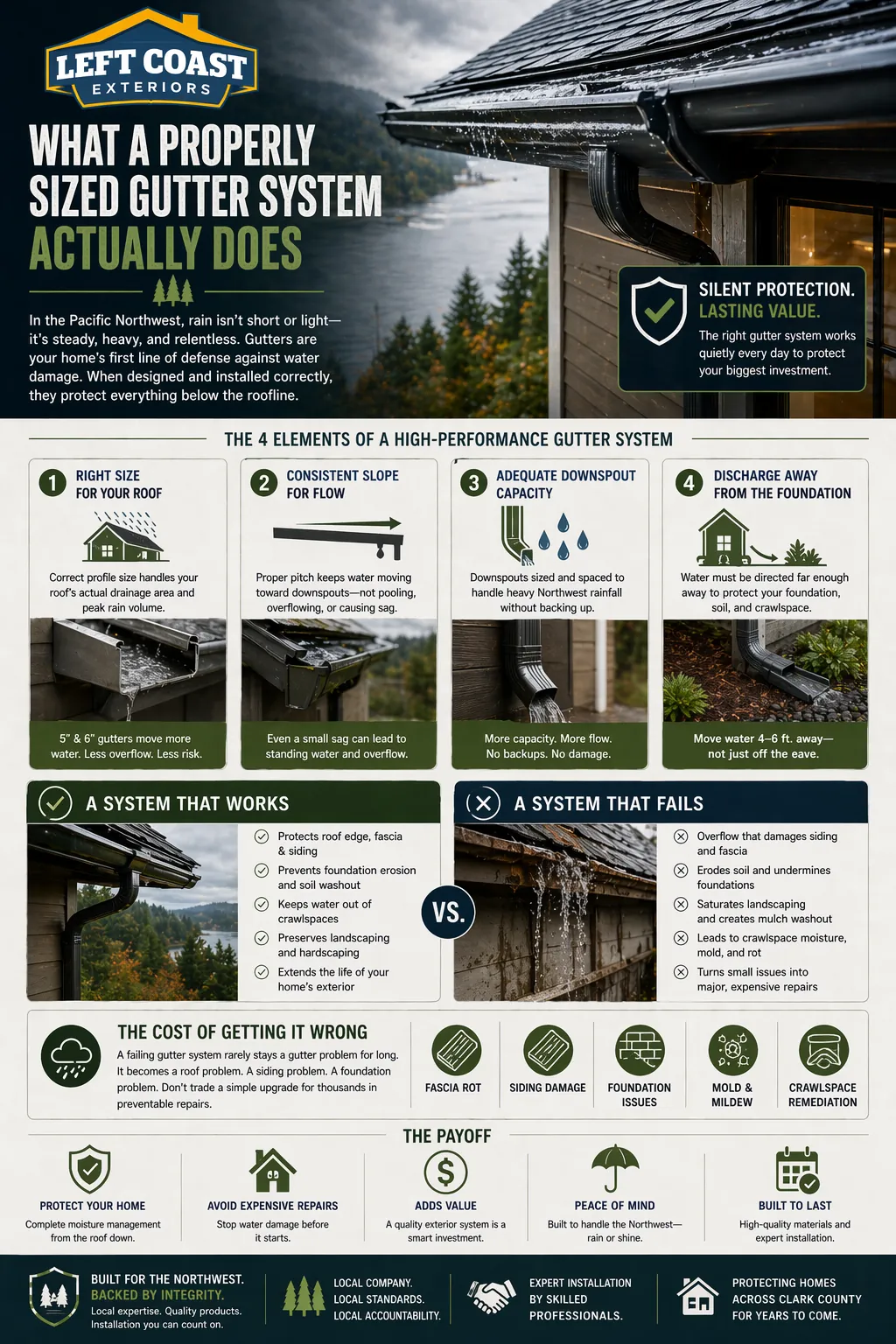
What a Properly Sized Gutter System Actually Does

In the Pacific Northwest, gutters aren't a cosmetic addition. They're a core component of your home's moisture-management system. Your roof sheds thousands of gallons of water annually, mostly delivered in long, sustained rain events that hit hard and last for weeks. Without an effective gutter system to collect and route that water, it falls off your eaves and creates damage that's both preventable and expensive: eroding soil at the foundation, splashing back onto siding, saturating landscaping beds against the house, and working into crawlspaces during the heaviest November and December events.

A properly designed gutter system means four things working together: the right profile size for your roof's actual drainage area, channels pitched at a consistent slope so water flows toward downspouts rather than pooling mid-run, adequate downspout capacity to handle peak rain volume without backing up, and downspout termination that moves water meaningfully away from the foundation, not just off the eave. When those four elements are correct, the system works silently and invisibly to protect your roof edge, siding, fascia, foundation, and landscaping simultaneously.

When any element is wrong, or when a system has aged past its service life, you're trading a relatively straightforward gutter replacement against much more expensive downstream repairs: fascia rot, siding water damage, foundation waterproofing, crawlspace remediation. We identify failed gutter systems as a contributing factor on a significant portion of the roofing and siding estimates we run in Clark County each year.
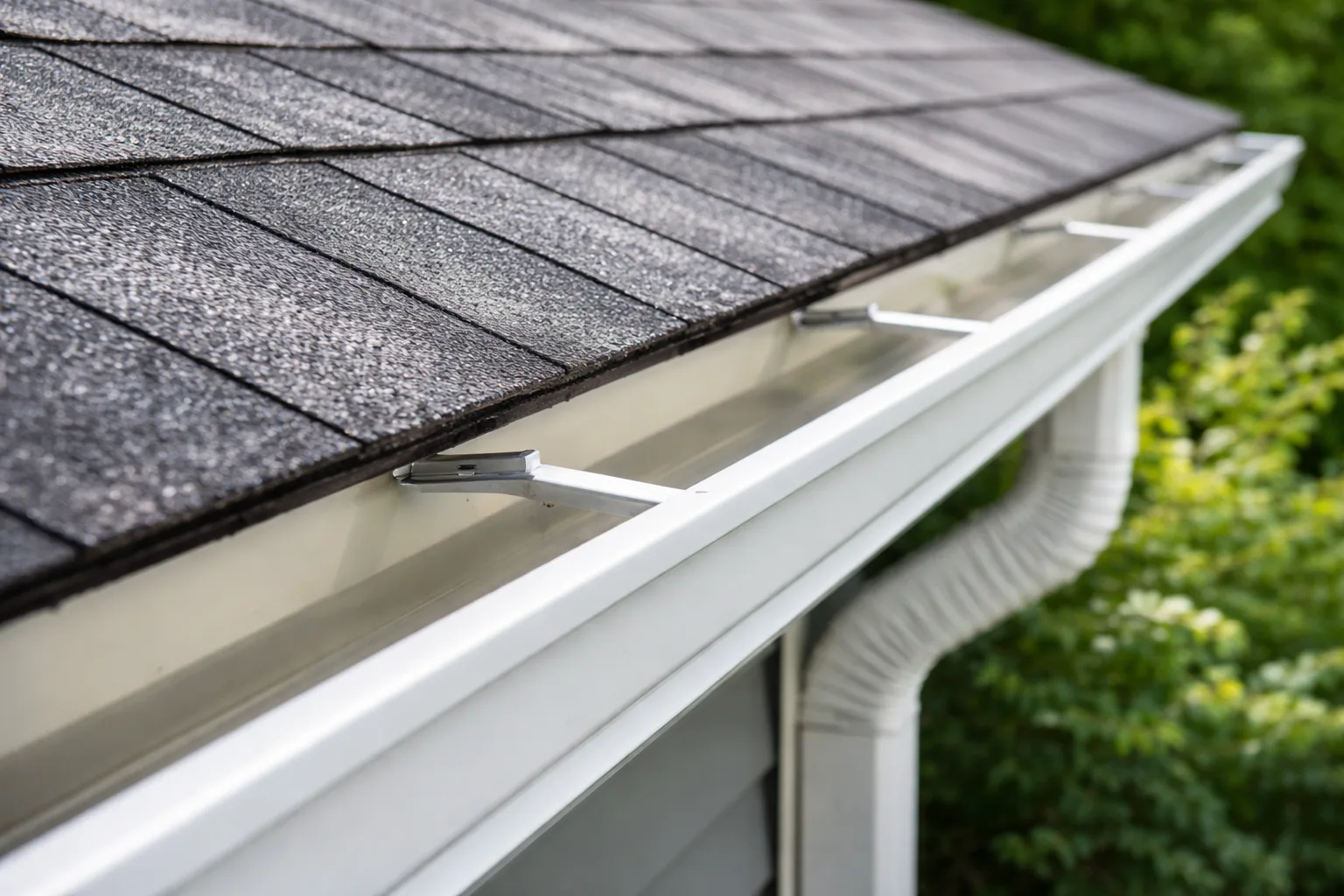
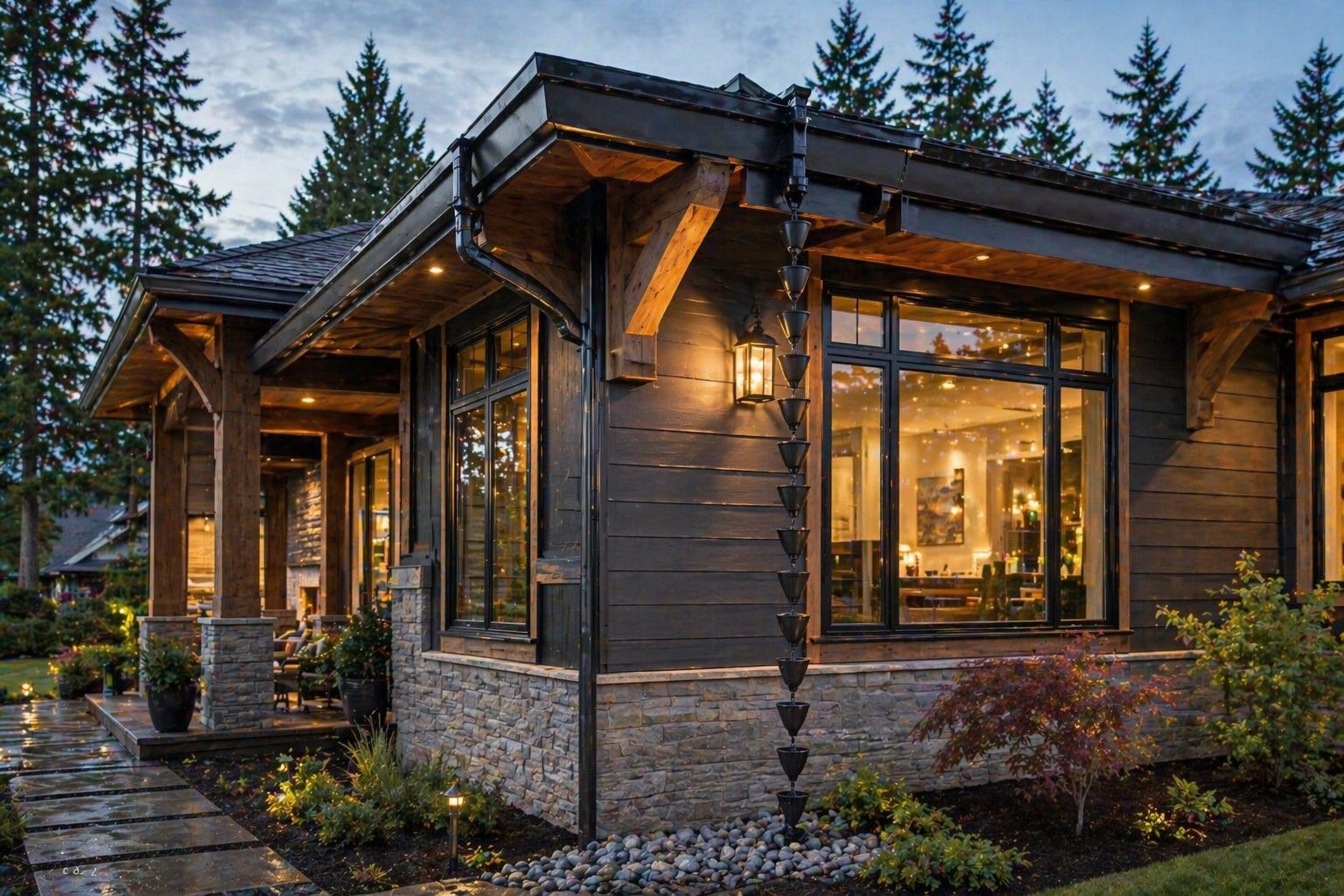
Seamless gutter installation on a Clark County home by Left Coast Exteriors
Get a Free Estimate
No obligation. Usually within 1 business day.
Call or Text
360-605-0250
Request a Free Estimate
Licensed & Insured in WA & OR
Seamless On-Site Fabrication
Itemized Written Estimates
Local Crews, No Subcontractors
How a properly sized gutter system works: profile sizing, pitch, downspout capacity, and termination — Left Coast Exteriors
Making the Right Call

Repair or Replace? Here's the Honest Answer.

Gutter repairs make sense when the problem is truly isolated. But multiple failure points, chronic overflow, or system-wide age usually means the repair math doesn't work in your favor.

When Repair Makes Sense

Gutter Repair

  • A single joint or end cap leaking on an otherwise sound system: reseal and it holds
  • One or two hangers pulled from intact fascia: re-anchoring is straightforward
  • A single bent or damaged section in a newer installation
  • Downspout has disconnected at the elbow or outlet
  • Gutters are less than 10 years old and the issue is clearly isolated, not part of a pattern
When Replacement Is the Right Move

Full Gutter Replacement

  • System is 20+ years old and showing multiple failure points simultaneously
  • Gutters consistently overflow during moderate rain: undersizing, not debris
  • Fascia boards have rotted under the gutter line: the attachment point is compromised
  • Sectional gutters with five or more leaking joints: repair economics stop making sense
  • You're replacing roofing or siding. Pairing gutters into the same project saves mobilization cost and ensures clean drip-edge integration
Gutter Systems We Install

Gutter Options for Clark County Homes

Most Clark County homes need a reliable, correctly sized seamless aluminum system. Some benefit from a larger profile for high-drainage-area roofs. Others are good candidates for copper or gutter protection systems. Here's what we install and why each type fits a specific situation.

Most Installed · Best Value

Seamless K-Style Aluminum

Seamless aluminum K-style gutters are the standard for residential gutter replacement in the Pacific Northwest, and for good reason. Unlike sectional gutters that use overlapping joints sealed with caulk, seamless gutters are formed on-site from a continuous aluminum coil using portable roll-forming equipment. The result is a gutter with no joints along its run length: no joints to leak, no seams to track, no sealant maintenance cycle. K-style profile (flat bottom, decorative ogee front face) handles high water volume efficiently and matches the trim profile of most homes built in Clark County over the past 60 years. Standard 5" K-style handles the drainage load of most residential roof sections at local rainfall rates. Homes with steeper pitches, wide roof planes, or roofs that collect drainage from an upper run into a lower gutter are often better served by 6" gutters. We evaluate this during the estimate visit and specify what's actually right for your home's geometry.

Craftsman & Period Homes

Half-Round Gutters

Half-round gutters (a semicircular trough rather than the flat-bottomed K-style) are the historically and architecturally appropriate choice for craftsman bungalows, Victorian-era homes, and other period styles where K-style would look wrong on the house. Half-round profiles flow more smoothly than K-style (no flat bottom where sediment and water can pool) and are less prone to debris accumulation over time. Available in aluminum, galvanized steel, and copper. For older homes in Vancouver's historic neighborhoods, or craftsman-style builds throughout Clark County, half-round gutters are both the correct aesthetic choice and a genuinely functional one. We assess your home's architectural style during the estimate and will tell you clearly which profile belongs on your house.

Premium · Lifetime Material

Copper Gutters

Copper is the premium gutter material: a lifetime product in both K-style and half-round profiles that requires no painting, no periodic resealing, and minimal maintenance over its lifespan. Copper develops a natural patina over time (progressing from bright new copper to brown to the characteristic blue-green verdigris) that most homeowners on the right architectural style find aesthetically desirable, not a problem. The cost premium over aluminum is significant. But copper gutters installed correctly outlast the structure they're attached to and require almost no maintenance investment over that lifespan, while aluminum gutters, even seamless, will typically need replacement within 25–30 years. For high-value homes where long-term durability and appearance both matter, copper is worth a serious look. We can provide copper estimates alongside aluminum for direct comparison on any project.

High-Drainage Roofs

Oversized 6" Gutters

Standard 5" gutters are sized for the drainage load of typical residential roof sections under average rainfall rates. In the Pacific Northwest, rain arrives in sustained, high-volume events that can easily exceed the design flow rate of an undersized system, resulting in overflow that's not caused by debris, but by the gutter simply not being large enough for the roof it's draining. Homes with steeply pitched roofs, wide unbroken roof planes, or upper-level drainage collecting into a lower gutter run are good candidates for 6" gutters. Downspout sizing matters equally. A 6" gutter discharging through a standard 2"×3" downspout creates a bottleneck that defeats the upgrade. We size gutter profile and downspout capacity together and explain the calculations in the written estimate so you understand exactly why the specification is what it is.

Reduce Cleaning Frequency

Gutter Guards & Covers

Gutter guards (screens, micro-mesh systems, and solid-cover designs) reduce the frequency of cleaning by limiting how much leaf and debris matter enters the gutter channel. They don't eliminate maintenance entirely (pine needle debris, shingle granules, and roof sediment still require periodic attention), but for homes with significant deciduous tree canopy, a quality micro-mesh guard system can meaningfully reduce how often the gutters need to be cleared. We install micro-mesh and screen systems that fit the gutter profiles we carry. We're also candid about what guards don't do: no system is fully maintenance-free, and homes with heavy conifer debris above them benefit less than homes with leaf-shedding trees. We don't upsell guards as a universal solution, but for the right home situation, they're a worthwhile addition that reduces a recurring nuisance.

Pacific Northwest Context

Why Gutters Are a Priority Here, Not an Afterthought

In drier climates, gutters are a modest convenience. In Clark County, they're actively protecting five separate systems of your home, often invisibly, until they fail.

Foundation & Crawlspace Protection

Clark County soils have significant clay content, which means drainage is slow and water lingers at grade level. Gutters that overflow or discharge without adequate downspout extension deposit that water at the worst possible location: directly against the foundation wall. Over time, that moisture finds joints, cracks, and vents. Most of the crawlspace moisture issues we encounter during roofing estimates are attributable at least in part to failed or undersized gutter systems.

Siding & Sheathing Protection

Gutter overflow that runs down the face of a house is a siding problem. Water that runs behind a gutter, from a failed joint or a gutter pitched the wrong direction, goes straight behind the cladding and into the sheathing layer. Wood sheathing exposed to repeated wetting will rot. Fiber cement is moisture-resistant but not immune if water is reaching it continuously from behind. We see gutter-related sheathing damage as a contributing factor on a regular basis during James Hardie siding projects in Clark County.

Fascia & Soffit Protection

The fascia board is what your gutter hangs from. When a gutter holds standing water (because it's pitched wrong, clogged, or overloaded), that water works behind the gutter and against the fascia continuously. Rotted fascia is one of the most common secondary findings when we pull off a failed gutter system. A gutter that's been running water behind it for years frequently requires fascia board replacement before the new system can be properly attached, adding scope that wouldn't have been necessary with a properly functioning gutter.

Landscape & Erosion Control

Water falling from an uncontrolled eave line hits the soil at grade with significant force during heavy events. That impact erodes landscaping beds, displaces mulch, and creates compaction channels against the foundation. Downspout extensions also need to be long enough to move water a meaningful distance from the house. A 6" splash block extension does almost nothing in a sustained Pacific Northwest rain event. We evaluate downspout routing and termination distance as part of every gutter installation.

Roof Edge & Drip Edge Protection

A properly installed gutter catches water coming off the drip edge and routes it cleanly to the downspout. A gutter that has sagged at the attachment point, is pitched away from the roof, or has a gap at the fascia allows that water to fall behind the channel. That gap is also where insects and debris accumulate over time. The connection between drip edge flashing, fascia, and gutter is a detail we check on every installation. It's one of those small things that makes a real difference over a 20-year service life.

Why Left Coast Exteriors

Why Clark County Homeowners Choose Us for Gutters

We Size for Your Actual Roof

Gutters should be sized based on your roof's actual drainage area and pitch, not defaulted to whatever profile is cheapest or most common. We evaluate your roof's load during the estimate visit and specify the right gutter profile and downspout count for your home's geometry. If your roof warrants 6" gutters, we tell you that and explain the calculation. If 5" is genuinely sufficient, we don't upsize to inflate the ticket.

We Assess the Fascia Before We Install

A new gutter installed over rotted fascia is a gutter that's going to fail again, sooner than it should. We evaluate the condition of the fascia along the gutter line before any installation and flag rot or moisture damage in writing. If fascia repairs are needed, they're included in the project scope before the new system goes up, not as a surprise discovery once the old gutter is already off the house.

Seamless Fabrication On-Site

We bring the roll-forming equipment to your property. Seamless gutters are formed on-site from a continuous aluminum coil to the exact length of each run. No joints along the length, no caulked seams to track and re-seal. The only joints in a seamless system are at corners and downspout outlets, where joints are unavoidable, and we seal those correctly the first time. This is a real performance difference over sectional systems, not a marketing distinction.

How It Works

Our Gutter Installation Process

Most gutter replacement projects are completed in a single day. Here's what that day, and the steps leading up to it, looks like from first call to finished system.

01

Free On-Site Assessment

We visit your home to evaluate the existing gutter system: profile, slope, downspout count and sizing, fascia condition, and how the system terminates at grade. We document any rot, overflow evidence, or attachment failures and photograph problem areas so the written estimate is specific and justified rather than generic line items.

02

System Recommendation & Written Estimate

We provide a detailed written estimate specifying gutter profile, material, color, downspout sizing and count, any fascia repair scope, and gutter guard option if applicable. The estimate explains the reasoning behind each specification. You're not receiving a price on a line item you can't evaluate or compare.

03

Old System Removal & Fascia Inspection

We remove the existing gutter system carefully and evaluate the full fascia line with the gutters off, which sometimes reveals rot that wasn't visible from the ground. Any fascia repairs in scope are addressed before the new system goes up. All removed materials are hauled off the property; we don't leave debris in your driveway or landscaping.

04

On-Site Fabrication & Installation

Seamless gutter runs are formed on-site from a continuous aluminum coil to the exact length of each run. We install at the correct slope (typically 1/16" to 1/8" of drop per foot toward the downspout), attach with hidden hangers at appropriate spacing for our climate's rain load, and seal all miters and outlets. Downspouts are secured to the wall and terminated with adequate extensions at grade.

05

Final Walkthrough & Site Cleanup

We walk the full installation with you, confirm slope and attachment, review downspout routing, and go over care and maintenance. If gutter guards were installed, we explain how they work and what periodic maintenance they still require. The site is cleared of all debris and materials before we consider the job done.

Common Questions

Gutter Installation FAQs

What Homeowners Say

Real Results from Gutter Replacement Projects

Google Review

"We had standing water against our foundation every winter and couldn't pinpoint the source. Left Coast spotted it during a roofing estimate. Our downspouts were discharging at grade right against the house, and the back gutters were pitched wrong and holding water. New 6" seamless gutters with properly routed downspouts. Two full rainy seasons in and the problem has not returned."

Sarah W.
Vancouver, WA Seamless Gutter Replacement
Google Review

"Big maples over our roof meant clearing the gutters three times a year. It was getting old. Left Coast replaced our old sectional vinyl gutters with seamless aluminum and added micro-mesh guards throughout. One full year in, I've done one quick rinse of the guards after fall leaf-drop. The crew showed up on time, explained every decision, and the gutters look clean and fit well with our older craftsman home."

Jim & Karen B.
Camas, WA Seamless Gutters with Micro-Mesh Guards
Google Review

"Left Coast replaced our gutters at the same time as our roof. When they pulled the old gutters, they found rotted fascia on the back of the house that would have failed the new gutter attachment within a season. They included the fascia repair in the estimate, fixed it, and then installed 6" seamless gutters. The system drains completely now, even in the November events we've had. Good to work with a crew that catches the secondary problem before it becomes a bigger one."

Financing Available

Upgrade Your Gutter System Now. Pay Over Time.

A properly sized seamless gutter system protects your foundation, siding, and fascia from day one. Financing lets you make the upgrade without waiting on the budget.

0% Intro APR Options
$0 Down for Qualified Buyers
12–84 Month Terms
Ask About Financing

Gutters are often most cost-effective when combined with a roofing or siding project. One mobilization, one crew, and cleaner integration at the drip edge and fascia line.

Financing offered through third-party lenders. Subject to credit approval. Ask your project consultant for current terms and available programs.

Request a Free Estimate

Other Services

Gutter Installation Across Clark County & Portland Metro

We serve homeowners throughout Southwest Washington and the greater Portland area. View full service area →

Vancouver, WA Camas, WA Battle Ground, WA Washougal, WA Ridgefield, WA Salmon Creek, WA Hazel Dell, WA Portland, OR Beaverton, OR Lake Oswego, OR Tigard, OR Happy Valley, OR

Ready for a Gutter System That Actually Handles a Clark County Winter?

Free estimate. Itemized written quote. Seamless aluminum fabricated on-site. Same-business-day response for most Clark County homeowners.